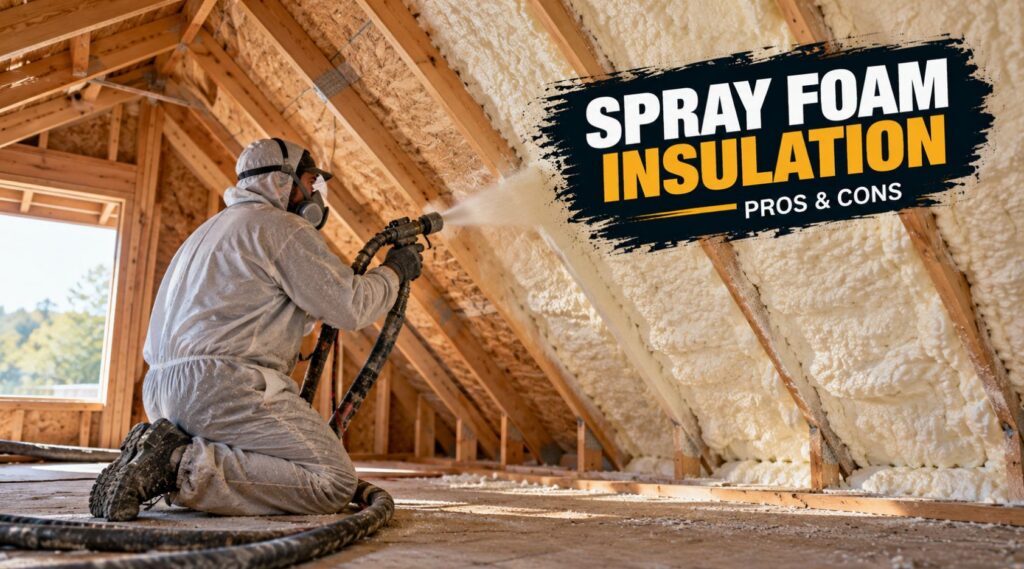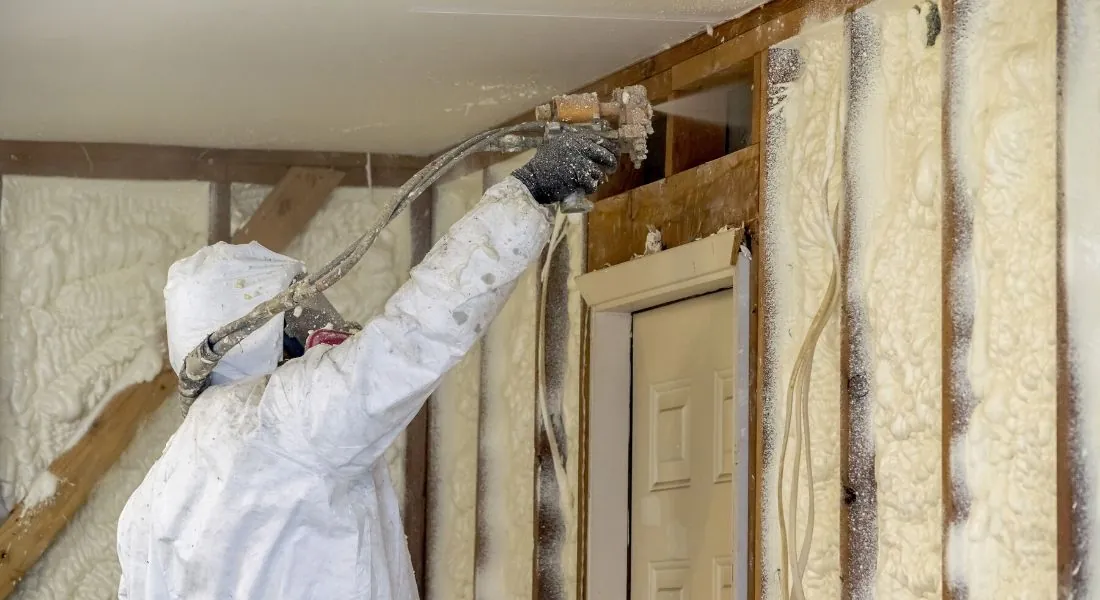
If you’re planning a new build, a renovation, or an attic and crawl space upgrade, you’ve probably run into the same question every homeowner faces once they start researching insulation: open cell spray foam insulation or closed cell spray foam insulation — which one actually belongs in your home? Both are polyurethane-based sprays applied as a liquid that expands on contact, and both dramatically outperform fiberglass batts and blown-in cellulose when it comes to air sealing. But they are not interchangeable products. They differ in density, R-value, moisture behavior, structural contribution, and price, and choosing the wrong one for a given assembly can cause real problems down the road — trapped moisture, mold, or wasted money on a spec that doesn’t match your climate.
This guide breaks down exactly how open cell and closed cell spray foam differ, where each one performs best, and how to decide which is right for your project.
What Is Open Cell Spray Foam Insulation?
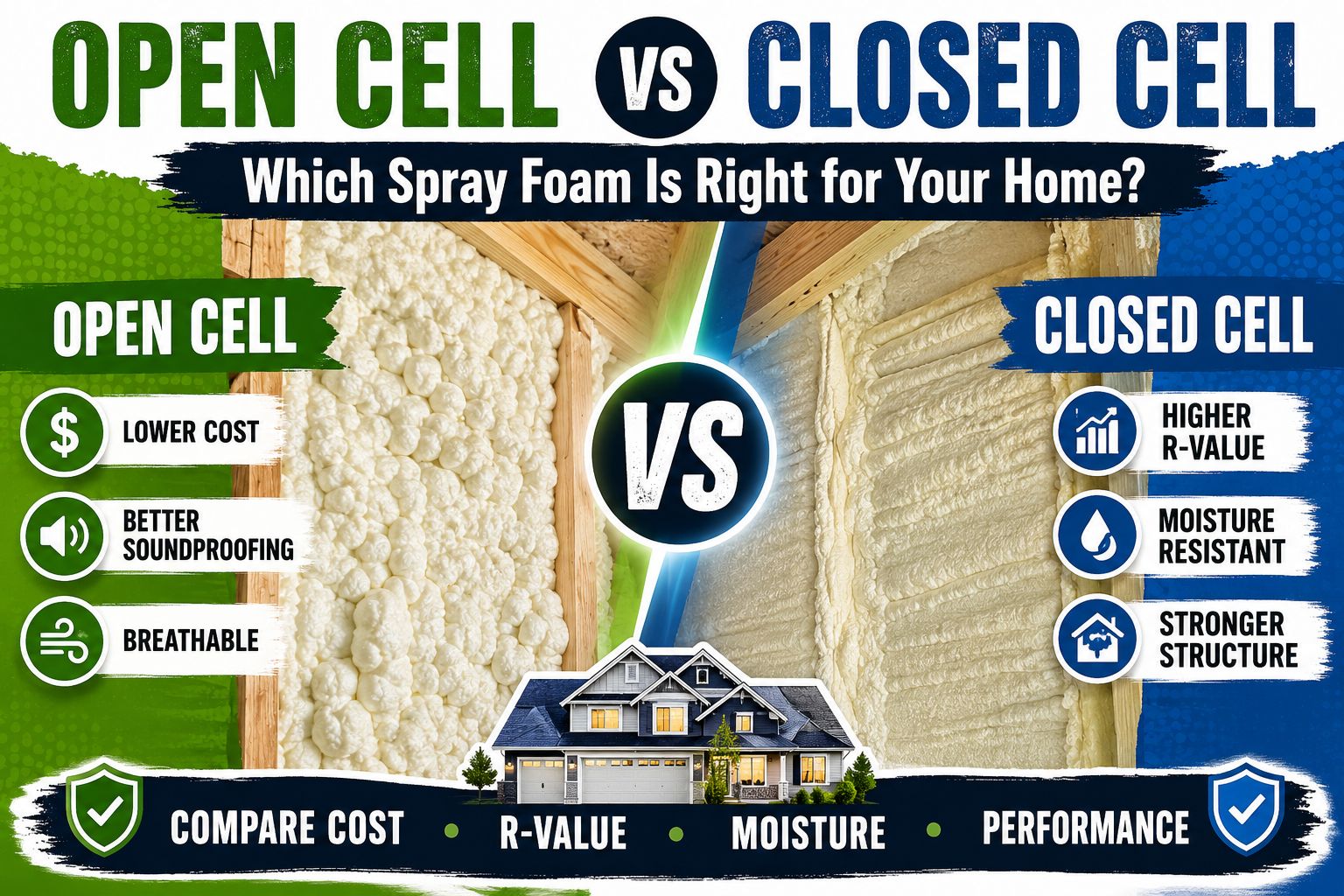
Open cell spray foam is a lighter, softer foam. During the spraying process, the tiny cells that form as the foam expands are left open and not fully encapsulated, which is why the material stays flexible and spongy to the touch once cured. That open-cell structure is also what gives it a lower R-value per inch than closed cell foam — typically around R-3.5 to R-3.6 per inch — but it expands far more per unit of material, which is one reason it’s often cheaper to install.
Because the cell structure isn’t sealed, open cell foam is vapor-permeable, meaning it allows some moisture vapor to pass through it rather than blocking it outright. It also absorbs water if it gets wet, so it isn’t a suitable choice anywhere it could be exposed to standing water or consistent moisture intrusion.
Where Open Cell Foam Works Best
- Interior wall cavities and interior partition walls, primarily for sound dampening
- Attic roof decks and rafters in warmer, drier climates
- Cathedral ceilings where a vapor-open assembly is desired
- Large-volume cavities where filling depth matters more than R-value per inch
- Retrofit projects where budget is a primary constraint
What Is Closed Cell Spray Foam Insulation?
Closed cell spray foam uses a denser formulation. As it cures, the individual cells close in on themselves and pack tightly together, creating a rigid, hard surface rather than a soft one. That tighter structure is what pushes the R-value up to roughly R-6 to R-7 per inch — nearly double what open cell offers — which means you can hit a target R-value with a much thinner application.
The closed-cell structure also makes the foam largely impermeable to both air and water. At around 1.5 to 2 inches of thickness, closed cell foam functions as a Class II vapor retarder, and it resists water absorption well enough that it’s routinely used in flood zones, crawl spaces, and rim joists where moisture exposure is a real risk. There’s a structural benefit as well: because it’s rigid and adheres tightly to framing, closed cell foam adds meaningful racking strength to a wall assembly — some testing has shown it can increase a wall’s resistance to lateral force significantly compared to unfilled framing.
Where Closed Cell Foam Works Best
- Basements, crawl spaces, and rim joists exposed to ground moisture
- Cold climates where a higher R-value per inch is needed in limited cavity depth
- Roof decks and flat roofs where both insulation and structural rigidity matter
- Flood-prone regions or coastal homes exposed to storm surge
- Exterior walls where maximizing R-value in a standard 2×4 or 2×6 cavity is the goal
Open Cell vs. Closed Cell: Side-by-Side Comparison
| Feature | Open Cell Spray Foam | Closed Cell Spray Foam |
| Density | ~0.5 lb/ft³ (soft, spongy) | ~2.0 lb/ft³ (rigid, dense) |
| R-value per inch | Roughly R-3.5 to R-3.6 | Roughly R-6 to R-7 |
| Water resistance | Absorbs water; not a moisture barrier | Water-resistant; acts as a barrier |
| Air sealing | Excellent | Excellent |
| Vapor permeability | Vapor-open (breathable) | Vapor-closed (acts as a vapor barrier at ~1.5–2 in.) |
| Structural rigidity | None — does not add strength | Adds significant racking strength to framing |
| Sound dampening | Very good (softer, more absorptive) | Good, but less absorptive than open cell |
| Typical cost per board foot | Lower | Higher |
| Best climates | Warmer, drier climates; interior walls | Cold, humid, or flood-prone climates |
R-Value: Why Density Changes the Math
R-value measures a material’s resistance to heat flow, and it scales with density in spray foam. Open cell foam’s lighter, more open structure means more air pockets and slightly weaker resistance per inch, so a standard 2×4 wall filled edge to edge with open cell foam lands around R-13, while the same cavity filled with closed cell foam can reach R-22 or higher. In a shallow cavity like a 2×6 rafter bay in a low-slope roof — that difference can be the deciding factor, since closed cell foam lets you hit code-minimum R-values without furring out the framing. For a deeper look at how R-value targets vary by region, see our full guide to spray foam R-value by climate zone.
Moisture, Vapor Control, and Climate
This is where the two products diverge the most, and it’s the single biggest factor in choosing correctly. Open cell foam is vapor-open, so moisture vapor can migrate through it, which works fine in many wall assemblies but becomes a liability in humid climates or below-grade applications where bulk water is a risk — the foam itself will absorb and hold moisture rather than shedding it. Closed cell foam’s tighter cell structure blocks both air and, at sufficient thickness, water vapor, which is why building codes and insulation contractors default to closed cell foam in basements, crawl spaces, and any application below grade.
Climate zone matters too. In hot, humid regions, vapor control decisions get more complicated because the direction of vapor drive changes seasonally, and an experienced local contractor should weigh in on assembly design rather than relying on a one-size-fits-all rule. As a general guideline, colder and wetter climates lean toward closed cell foam, while warmer and drier climates have more flexibility to use open cell foam, particularly above grade.
Cost Considerations
Open cell foam typically runs less per board foot than closed cell foam, and because it expands to a larger volume from the same amount of raw material, the installed cost gap is often even wider than the per-board-foot pricing suggests. That said, cost per board foot isn’t the whole story. Because closed cell foam delivers a higher R-value per inch, achieving the same total R-value in a given assembly may require a thinner, and sometimes less expensive overall, application of closed cell foam compared to a much thicker layer of open cell foam. We break down real installed price ranges in our spray foam insulation cost guide, but getting an actual quote for your specific project — factoring in cavity depth, square footage, and target R-value — is the only reliable way to compare true installed cost between the two.
Structural and Sound Performance
Closed cell foam’s rigidity gives it a structural role that open cell foam simply doesn’t have. Once cured, it bonds tightly to studs and sheathing and adds meaningful resistance to wind and seismic racking forces, which is part of why it’s popular in hurricane-prone regions and pole barn or metal building construction. Open cell foam, by contrast, stays soft and pliable, which actually works in its favor for sound dampening — its more absorptive structure does a better job of reducing airborne noise transmission between rooms, making it a common choice for interior partition walls, media rooms, and multi-family construction where noise control between units matters.
Can You Use Both in the Same Home?
Yes, and in many projects that’s exactly the right call. It’s common to see closed cell foam used in a basement and crawl space insulation for moisture control and structural benefit, while open cell foam is used in the attic and roof deck, upper-floor exterior walls, and interior partitions where sound dampening and cost matter more than moisture resistance. A hybrid approach lets you put the right product where it performs best instead of over-specifying (and overpaying for) closed cell foam everywhere, or under-specifying open cell foam somewhere it can’t handle the moisture load.
How to Decide Which One You Need
A few questions can narrow the decision quickly:
- Is the area below grade or exposed to potential water contact? If yes, closed cell foam is almost always the right call.
- Is cavity depth limited? Closed cell foam’s higher R-value per inch helps you hit code minimums in shallow framing.
- Is soundproofing between interior rooms the main goal? Open cell foam’s absorptive structure tends to perform better here.
- Is budget the primary driver for a large attic or above-grade cavity in a mild climate? Open cell foam often makes more financial sense.
- Does the wall need added structural rigidity, such as in a high-wind zone? Closed cell foam contributes real racking strength.
Local building codes also play a role — some jurisdictions require a specific vapor retarder class or minimum R-value that effectively narrows the choice for you, so it’s worth checking code requirements for your area before finalizing a spec.
Working With a Qualified Installer
Both open cell and closed cell spray foam are two-component systems mixed and sprayed on site, and correct application matters as much as product selection. Improper mixing ratios, incorrect lift thickness per pass, or spraying in the wrong ambient conditions can lead to off-ratio foam, shrinkage, or poor adhesion — problems that are difficult and expensive to fix after the fact. Our guide to hiring a spray foam contractor covers the questions to ask before you sign a quote. A qualified, experienced spray foam contractor will assess your specific assembly, climate zone, and code requirements, and recommend (or combine) the right product for each area of the home rather than applying a single product everywhere by default.
FAQ
Is open cell or closed cell spray foam better?
Neither is universally better. Open cell spray foam is ideal for interior walls, soundproofing, and warm climates, while closed cell spray foam offers a higher R-value, moisture resistance, and added structural strength for basements, crawl spaces, and colder climates.
Is closed cell spray foam worth the extra cost?
Yes, if you need maximum insulation, moisture protection, or structural reinforcement. Although it costs more upfront, its higher R-value per inch can improve energy efficiency over time.
Can open cell spray foam get wet?
Yes. Open cell spray foam can absorb water, making it unsuitable for areas exposed to frequent moisture or flooding. Closed cell foam is a better choice for damp environments.
Can you use both open cell and closed cell spray foam in the same house?
Yes. Many homeowners use closed cell foam in basements, crawl spaces, and rim joists, while using open cell foam in attics and interior walls to balance performance and cost.
Which spray foam has the higher R-value?
Closed cell spray foam provides approximately R-6 to R-7 per inch, while open cell spray foam typically delivers around R-3.5 to R-3.6 per inch.
The Bottom Line
Open cell and closed cell spray foam insulation both air-seal far better than traditional fiberglass or cellulose, but they solve different problems. Open cell foam is softer, less expensive, and better at sound dampening, making it a strong fit for interior walls and above-grade attics in moderate climates. Closed cell foam is denser, more expensive, and delivers roughly double the R-value per inch along with real moisture resistance and structural rigidity, making it the better choice for basements, crawl spaces, cold climates, and anywhere structural strength or moisture control is a priority. Many homes benefit from using both, matched to the right location. Talking through your specific project with an experienced local installer is the best way to land on a spec that performs well for decades rather than one that just looks good on paper.
Get free quotes from spray foam pros — about a minute, no obligation.
Get free quotesAsk the forum. Applicators and building pros answer — no account needed.
Ask a pro