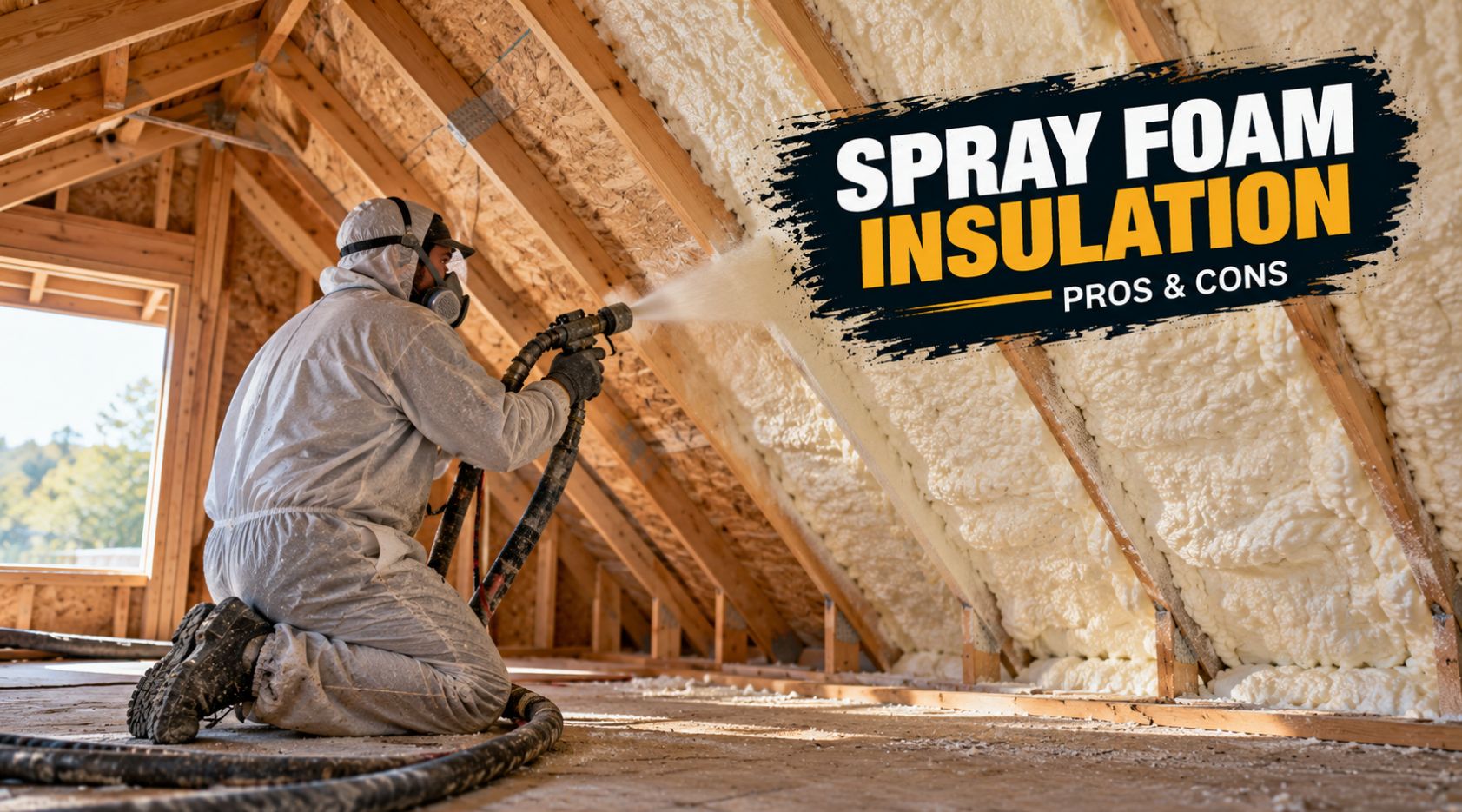
If you’ve priced out insulation lately, you’ve probably noticed that spray foam sits at the top of almost every quote, and that the person pitching it tends to sound very sure of themselves. Sometimes they have good reason to be. Sometimes they’re glossing over things you’d want to know before writing the check. Spray foam insulation pros and cons are both real, and a homeowner deciding between foam, fiberglass, and cellulose deserves to see both sides laid out plainly. This guide walks through what spray foam actually is, where it genuinely earns its price, where it causes headaches, and which questions are worth asking before anyone starts spraying inside your walls or attic.
What You’re Actually Buying
Spray foam insulation is a two-part chemical system. A resin side and an isocyanate side are mixed at the spray gun, and the reaction expands the material into foam as it hits the surface. Chemically, it’s a polyurethane, formed when the isocyanate reacts with a polyol. That’s a close cousin of polyurea but not the same thing: polyurea uses an amine instead of a polyol, which is why it cures far faster and behaves so differently as a coating. If you want the chemistry in more detail, our complete guide to polyurea coatings explains how those reactions differ and why it matters.
There are two main types, and they’re not interchangeable.
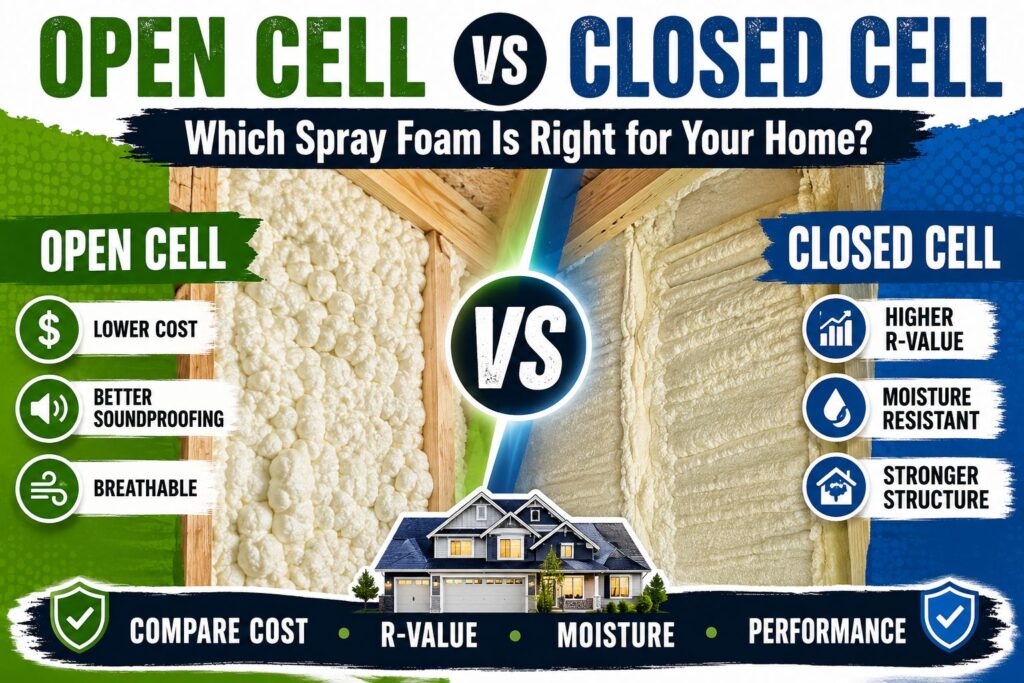
Open-cell foam has a soft, spongy structure with tiny cells that aren’t fully sealed. It’s lighter, expands a lot during application, costs less, and does a good job dampening sound. It’s vapor-permeable, which means moisture vapor can move through it.
Closed-cell foam is dense and rigid, with sealed cells. It delivers more insulating value per inch, adds some structural stiffness to the assembly, and acts as a vapor retarder and, in sufficient thickness, an air barrier. It also costs noticeably more.
Spray Foam Insulation Pros and Cons at a Glance
| Factor | Advantage | Drawback |
|---|---|---|
| Air sealing | Fills gaps and cracks as it expands, cutting air leakage | Poorly applied foam can leave voids that quietly undermine this |
| Insulating value | Strong R-value for the thickness, especially closed-cell | Value varies by product and installer skill, so verify the actual spec |
| Moisture | Closed-cell resists moisture and acts as a vapor retarder | Can trap moisture in some assemblies if the building design isn’t thought through |
| Cost | Can reduce energy bills over time | Higher upfront cost than batt or blown-in insulation |
| Installation | Fast once the crew is on site | Requires trained professionals and proper equipment |
| Longevity | Doesn’t sag or settle the way some loose-fill products can | Very difficult to remove or modify later |
| Comfort | Fewer drafts and more even temperatures | Odor and cure concerns when done incorrectly |
The Real Advantages
The strongest argument for spray foam is air sealing. Most houses lose a surprising amount of conditioned air through small gaps around framing, rim joists, wiring penetrations, and attic hatches, and insulation that only resists heat flow does nothing about moving air. Foam expands to fill those gaps as it’s applied, which is why it often makes older, drafty homes noticeably more comfortable in a way that’s easy to feel and not just measure.
Space limitations are another genuine plus. In a cathedral ceiling, a narrow wall cavity, or an oddly shaped crawlspace, there often isn’t room for the thickness that fiberglass would need to hit a target insulation value. Closed-cell foam delivers more resistance per inch, so it can make sense precisely where other products run out of room.
Foam also doesn’t slump or settle over time the way loose-fill insulation sometimes does, and closed-cell foam handles incidental moisture better than most alternatives. In basements and rim joist areas where dampness is a recurring issue, that resilience is a real selling point rather than marketing language.
The Real Drawbacks
Cost comes first, and it isn’t a small gap. Spray foam generally runs well above fiberglass batts or blown cellulose on a per-square-foot basis. The energy savings are real but they’re not instant, and whether the payback timeline makes sense depends on your climate, the existing condition of your house, and how long you plan to stay in it. Anyone promising a specific number of years without looking at your actual home is guessing.
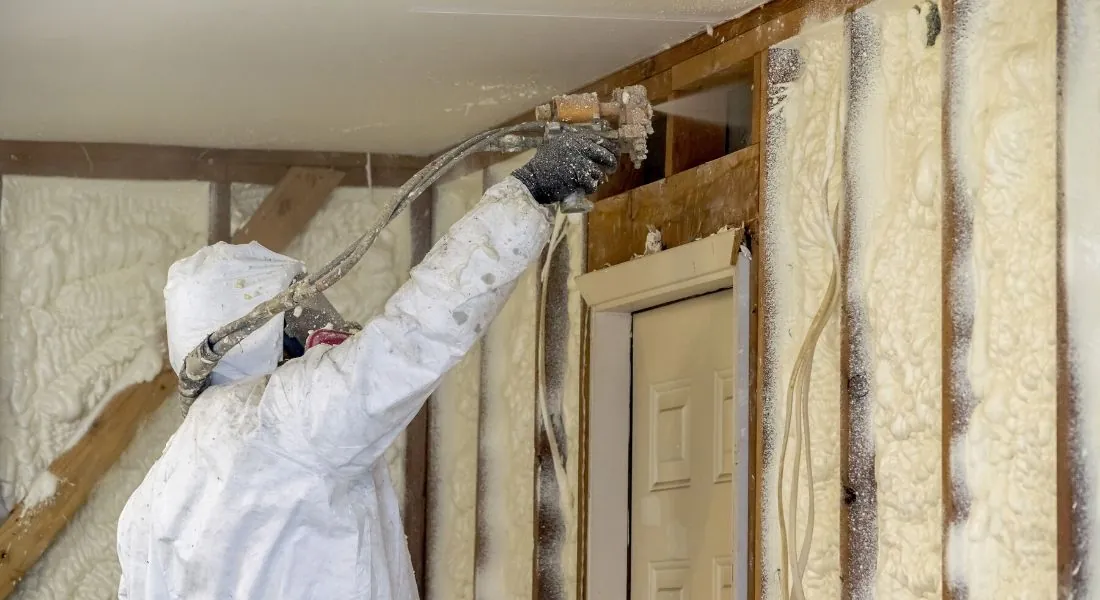
Installation quality matters more with foam than with almost any other insulation product. The material is mixed on site, and if the two components aren’t properly proportioned, or the substrate is too cold or too damp, the foam can cure badly. Off-ratio foam can produce persistent odor, poor adhesion, or shrinkage, and once it’s inside a closed wall, fixing it is expensive and disruptive. This is the single biggest reason to care less about the product brand and more about who’s holding the spray gun.
Re-entry after installation is another point where homeowners deserve clear answers. Installers and manufacturers publish guidance on how long a space should stay unoccupied and ventilated after foam goes in, and those instructions come from the specific product’s technical and safety documentation. Follow the manufacturer’s and installer’s written guidance and the product’s safety data sheet rather than a general rule of thumb you read online, including this one.
Fire safety is handled through building code. Foam plastics are combustible, so codes generally require them to be covered by a thermal barrier or, in some attic and crawlspace situations, an ignition barrier. Your local code and inspector govern the details, and any reputable installer should be able to explain which requirement applies to your project.
Moisture design is a subtler issue. Closed-cell foam in an unvented attic or against roof sheathing can work well when the whole assembly is designed for it, and it can create problems when it isn’t. If you have a history of roof leaks, ask the installer how they’ll confirm the roof deck is dry and sound before it gets sealed in behind foam, because a hidden leak behind a layer of closed-cell foam can go undetected far longer than it would in an open, inspectable attic.
Finally, there’s permanence. Foam is hard to remove cleanly. If you later need to rewire, repair plumbing, or inspect framing behind it, you’re cutting and scraping, and that matters if you think you might want flexibility down the road.
Open-Cell vs. Closed-Cell: Matching the Product to the Space
For interior walls where sound control matters and the budget is tight, open-cell foam can be a sensible choice. It’s softer, expands more, and costs less, though its vapor permeability means it needs to be used where that characteristic works with the building design rather than against it.
For basements, rim joists, crawlspaces, and exterior-facing assemblies where moisture and limited space are the concerns, closed-cell foam tends to be the better fit despite the higher cost. Its density also adds stiffness to the framing assembly, which some builders count as a secondary benefit.
Neither is automatically the right answer for an entire house. Plenty of well-built projects use closed-cell in the places that need it and a cheaper insulation elsewhere, which is often the most cost-effective way to get the benefits of foam without paying for it everywhere.
Where Polyurea Fits In, and Where It Doesn’t
Because this resource covers polyurea, it’s worth being clear about the overlap. Polyurea is a coating, not an insulation product. It’s valued for waterproofing, abrasion resistance, and fast cure, not for thermal resistance. The two do meet in one place: spray polyurethane foam roofing systems typically get a protective coating on top of the foam to shield it from UV exposure and weather, and that coating layer is sometimes a polyurea or polyurethane product. For a broader look at how these chemistries get used across industries, our applications and use cases page covers where polyurea is commonly specified, and our industry glossary defines terms like open-cell, closed-cell, and plural-component equipment if you want a quick reference while reading contractor quotes.
Questions Worth Asking Before You Hire an Installer
Ask which specific product they plan to use and request the technical data sheet and safety data sheet for it. A confident installer will hand them over without hesitation.
Ask how they verify proper mix ratio and substrate conditions on the day of installation, since cold or damp surfaces can compromise how foam cures.
Ask what thickness they plan to install and what installed value that thickness is expected to deliver according to the product documentation, instead of accepting a general claim about “high R-value.”
Ask how fire and thermal barrier requirements will be met on your project and whether the work will be inspected.
Ask what the written re-entry and ventilation instructions are for your specific job and product, and get them in writing.
Ask for references from recent jobs similar to yours, and if possible, look at a project that’s been in place for a year or two rather than one finished last week.
How Long Does It Last, and Does It Need Maintenance?
Properly installed foam inside a protected building envelope generally needs little ongoing attention, which is part of its appeal. Exposed foam, such as on a roof, needs a protective coating and periodic inspection, since UV exposure degrades unprotected foam over time. Inside the home, the practical maintenance task is simply keeping the foam covered as required by code and avoiding drilling or cutting into it without understanding what’s behind it.
Frequently Asked Questions
Is spray foam insulation worth the extra cost?
It can be, particularly in leaky older homes, tight spaces, and moisture-prone areas. In a simple, well-sealed attic with plenty of room, a cheaper insulation product installed carefully may deliver most of the benefit for less money. The honest answer depends on your house, not a general rule.
What’s the difference between open-cell and closed-cell spray foam?
Open-cell is softer, lighter, and less expensive, and it allows moisture vapor to pass through. Closed-cell is denser, offers more insulating value per inch, and acts as a vapor retarder, but it costs more.
Is spray foam safe once it’s installed?
Cured foam inside a properly built assembly is generally considered stable. The concerns are mostly about the installation period and improper mixing, which is why following the manufacturer’s and installer’s written re-entry and ventilation guidance, and the product’s safety data sheet, matters.
Can I install spray foam myself?
Small-scale DIY foam products exist, but larger projects involve two-component equipment, tight control of mix ratio and surface conditions, and real safety requirements. Mistakes are expensive to undo, which is why most homeowners hire professionals for anything beyond sealing small gaps.
Will spray foam cause moisture problems in my attic?
It can if the roof deck is already damp or the assembly isn’t designed properly, and it can work very well when it is. Ask your installer how they’ll confirm the roof deck is dry and sound before sealing it in.
Can spray foam be removed later?
It can, but it’s slow and messy work, which is worth considering if you expect to rewire or renovate behind it in the future.
Conclusion
Spray foam insulation pros and cons come down to a trade: you pay more upfront for excellent air sealing, strong insulating value in tight spaces, and good moisture performance in the right applications, and in exchange you take on more dependence on installer quality and less flexibility to change things later. For some homes that trade is clearly worth making. For others, a well-installed conventional insulation does the job for less. The best decision comes from getting the product documentation, asking direct questions about moisture, fire barriers, and re-entry instructions, and choosing an installer based on their process and track record rather than the confidence of their pitch.
Get free quotes from spray foam pros — about a minute, no obligation.
Get free quotesAsk the forum. Applicators and building pros answer — no account needed.
Ask a pro